
New Research on Autism: What Parents Should Know
Autism research is growing quickly and helping scientists, doctors, and families learn more about Autism Spectrum Disorder (ASD). Below are recent findings from peer-reviewed studies that may be helpful for parents.
Could Many Autism Cases Be Preventable?
A 3-hit metabolic signaling model for the core symptoms of autism spectrum disorder
Things that could mitigate the cell danger response (CDR) referenced in the abstract from the ScienceDirect article “A 3-hit metabolic signaling model for the core symptoms of autism spectrum disorder” (Naviaux 2025), where CDR refers to a cellular metabolic stress response that, if prolonged, contributes to ASD risk:
✅ 1. Early Diagnosis & Risk Identification
-
Because the 2nd and 3rd hits (environmental triggers and prolonged CDR activation) are modifiable, identifying at-risk individuals before or early in life could allow intervention before CDR becomes chronic and thus reduce the development or severity of ASD symptoms. PubMed+1
✅ 2. Screening & Monitoring Metabolic Stress
-
Presymptomatic screening (e.g., maternal metabolomic profiling, autoantibody testing, specialized newborn assays) could track metabolic markers of CDR activation and guide early interventions. UC San Diego Today
✅ 3. Anti-purinergic Therapies
-
Naviaux and collaborators highlight drugs that modulate purinergic signaling — the extracellular ATP signaling that helps sustain the CDR — as therapeutic strategies. For example:
-
Suramin and other anti-purinergic agents are being explored to regulate abnormal cell ATP signaling to help “turn off” a persistent CDR. UC San Diego Today+1
-
✅ 4. Environmental & Trigger Reduction
-
Reducing exposure to environmental stressors that can activate or sustain the CDR (toxins, infections, nutritional insults, etc.) could prevent the initial or repeated triggers of CDR. This concept, while more general, underlies most strategies to avoid prolonged CDR activation. The Autism Community in Action
✅ 5. Metabolic Support & Cellular Health
Although outside the abstract itself, complementary sources describe how supporting cellular metabolism and inflammation may help resolve prolonged CDR:
-
Support mitochondria and cellular energy metabolism via nutrients, lifestyle factors, and therapies that improve mitochondrial function. The Autism Community in Action
-
Manage chronic stress and inflammation, which are core parts of prolonged CDR, through lifestyle, nutritional, or medical interventions aimed at lowering systemic and intracellular stress signals. Dr. Cynthia
Have a question or a comment?
Click here – your voice matters!
Gut Problems in Autism Linked to Sleep, Behavior, and Sensory Challenges
 Summary: A long-term study tracking 475 children found that autistic children are far more likely to experience persistent gastrointestinal issues than their peers. These symptoms often co-occur, persist across childhood, and strongly relate to challenges with sleep, communication, behavior, and sensory processing.
The findings underscore the need for clinicians and families to proactively address gut health as part of comprehensive autism care. By treating even unexplained GI symptoms, children may experience improvements in well-being and development.
Key Facts:
- Persistent Symptoms: Autistic children had more frequent and lasting gastrointestinal issues than peers.
- Wider Impact: Gut problems were tied to sleep, mood, communication, and sensory challenges.
- Care Priority: Treating GI symptoms could improve quality of life and developmental outcomes.
Source: UC Davis
That’s the finding of a new UC Davis MIND Institute study published in Autism. The research also found that these stomach and digestive issues are linked to greater challenges with sleep, communication, sensory processing and behavior.
The study followed 475 children between the ages of 2 and 12, including 322 children with autism and 153 with typical development. Families participated in detailed physician-led interviews at multiple time points. This allowed researchers to track both the frequency and persistence of gastrointestinal symptoms throughout childhood.
The findings show that autistic children were not only more likely to report GI problems, but they were also more likely to have multiple symptoms at once. It was also more likely for these symptoms to persist over many years. Importantly, these symptoms often did not have an identified medical cause. This highlights the need for clinicians and families to pay closer attention to children’s overall health and well-being.
“The connection between autism and gut symptoms has not been fully understood. Parents often sense that their child is having digestive issues, but can’t tell what is causing them,” said Bibiana Restrepo, the lead author of the study. She is a developmental pediatrician and a professor in the Department of Pediatrics.
“Our research shows that these symptoms are common, persistent, and can affect many areas of a child’s daily life. By identifying and treating them, we may be able to improve both physical comfort and developmental outcomes.”
Stomach problems beyond digestion
Researchers evaluated nine common gastrointestinal symptoms, including constipation, diarrhea, abdominal pain and bloating. While occasional digestive issues are common in all children, the study revealed striking differences between groups.
- Children with autism had more GI symptoms at every age studied.
- They were more likely to experience multiple GI symptoms at the same time.
- Their GI symptoms were more likely to persist across childhood, rather than resolve quickly.
These symptoms were strongly associated with other health and behavioral challenges. Children with more frequent GI issues also showed higher rates of:
- sleep difficulties
- anxiety
- irritability
- communication challenges
- sensory sensitivities
- repetitive behaviors
“This is a reminder that the brain and the body are deeply connected,” said the study’s senior author Christine Wu Nordahl. Nordahl is a professor of psychiatry and behavioral sciences and directs the Autism Phenome Project at the MIND Institute.
“When children are experiencing stomach pain or other GI problems, it doesn’t just affect digestion. It can influence sleep, mood, and how they interact with the world around them.”
Addressing common gut issues for children with autism
Although gastrointestinal problems in autism have been reported before, this study is the first analysis of GI symptoms in autistic kids from early to middle childhood. It is also among the largest and most rigorous to track these symptoms over a decade of childhood development.
The researchers emphasize that many GI symptoms are treatable, even when they don’t have an obvious medical diagnosis. Increased awareness among clinicians, educators and families can help ensure children get the care they need.
“For parents, this study validates what many have long observed: that GI symptoms are very common in children with autism,” Restrepo said. “Clinicians should ask about these issues in routine visits, because effective treatment may help children feel better and thrive.”
The team hopes their findings will lead to greater collaboration between pediatricians, gastroenterologists and autism specialists. By addressing GI health as part of comprehensive autism care, children may gain relief from symptoms that interfere with their growth and development.
“This is not about finding a single cause,” Nordahl added. “It’s about recognizing the whole child. Supporting gastrointestinal health is one important step toward improving overall quality of life for children with autism.”
Funding: This study was funded by the National Institute of Mental Health and the UC Davis MIND Institute. It was also supported by the MIND Institute Intellectual and Developmental Disabilities Research Center.
About this autism research news
Author: Nadine Yehya
Source: UC Davis
Contact: Nadine Yehya – UC Davis
Image: The image is credited to Neuroscience News
Original Research: Open access.
“A longitudinal evaluation of gastrointestinal symptoms in children with autism spectrum disorder” by Bibiana Restrepo et al. Autism
Have a question or a comment?
Click here – your voice matters!
This is exciting news for autism research because scientists may have found a new way to treat some autism-related behaviors. They discovered that a brain area called the reticular thalamic nucleus, which controls how sensory information gets processed, was overly active in mice. When this part of the brain was too active, the mice had seizures, repeated behaviors, and avoided social interaction.
The exciting part is that when researchers used certain medicines—including one already being tested for epilepsy—they were able to calm down this brain activity and reverse the behaviors. This suggests autism and epilepsy may share the same brain pathway and gives scientists a new target for future treatments.
Reticular thalamic hyperexcitability drives autism spectrum disorder behaviors in the Cntnap2 model of autism
Autism spectrum disorders (ASDs) are neurodevelopmental conditions characterized by social deficits, repetitive behaviors, and comorbidities such as sensory abnormalities, sleep disturbances, and seizures. Although thalamocortical circuit dysfunction has been implicated in these symptoms, its precise roles in ASD pathophysiology remain poorly understood. Here, we examine the specific contribution of the reticular thalamic nucleus (RT), a key modulator of thalamocortical activity, to ASD-related behavioral deficits using a Cntnap2 knockout mouse model. Cntnap2−/− mice displayed increased seizure susceptibility, locomotor activity, and repetitive behaviors. Electrophysiological recordings revealed enhanced intrathalamic oscillations and burst firing in RT neurons, accompanied by elevated T-type calcium currents. In vivo fiber photometry confirmed behavior-associated increases in RT population activity. Notably, pharmacological and chemogenetic suppression of RT excitability via Z944, a T-type calcium channel blocker, and via C21 activation of the inhibitory DREADD hM4Di significantly improved ASD-related behaviors. These findings identify RT hyperexcitability as a mechanistic driver of ASD and highlight RT as a potential therapeutic target.
Sung-Soo Jang et al. Reticular thalamic hyperexcitability drives autism spectrum disorder behaviors in the Cntnap2 model of autism. Sci.Adv. 11, eadw 4682(2025). DOI:10.1126/sciadv.adw4682
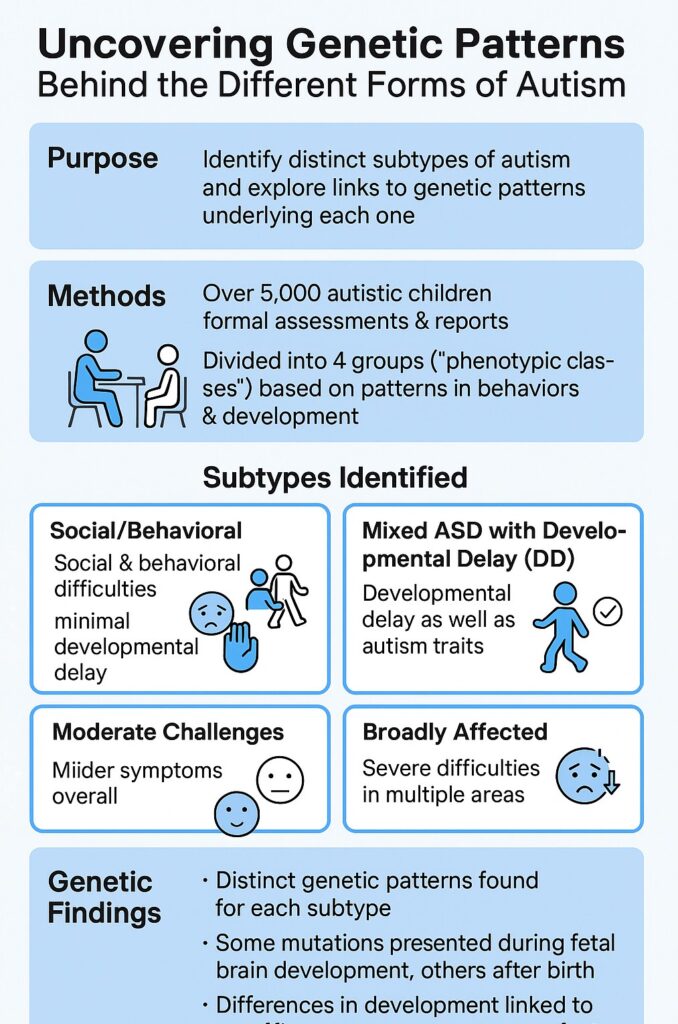
Decomposition of phenotypic heterogeneity in autism reveals underlying genetic programs.
(In English – Uncovering Genetic Patterns Behind the Different Forms of Autism)
🧠 Diagnosing Autism With or Without Early Developmental History – Insights from This Study
Traditionally, diagnosing autism relies on identifying symptoms that appear during the early developmental period, typically before age 3. This includes delays or differences in social interaction, communication, and behavior. Most diagnostic tools—like the DSM-5 and clinical interviews—require that signs of ASD begin in early childhood, even if they aren’t recognized until later.
However, this study found that not all autistic individuals show clear signs early on, and some have traits that emerge later or don’t fit the typical early developmental profile. Using data from over 5,000 children, the researchers grouped autistic individuals into four distinct classes based on behavior, co-occurring conditions, and developmental milestones.
Two key findings challenge the idea that early developmental differences must always be present or obvious:
- The Social/Behavioral group showed significant autism traits (like social and emotional difficulties) without developmental delays. Their average age for walking and speaking was close to that of their non-autistic siblings. Genetic analysis showed that this group’s gene variants were mostly active after birth, suggesting later developmental impacts.
- In contrast, the Mixed ASD with Developmental Delay group had much earlier signs of difference—delayed speech, walking, and other developmental milestones. Their gene disruptions were active mostly before birth, affecting brain development during the fetal period.
This shows that while early signs of autism can be very clear in some children, in others, the traits may become more noticeable later in development. These later-emerging presentations may still meet the criteria for ASD, but may be missed if clinicians rely too heavily on early delays alone.
🔍 What Does This Mean for Diagnosis?
- The study supports the idea that autism is not always detectable in EARLY childhood, especially for those children without language or developmental delays.
- Some children, especially those in the Social/Behavioral class, may not be diagnosed until school age, when social demands increase and difficulties become more apparent.
- Diagnostic criteria and clinical assessments should consider both early and later-developing signs, especially for children who have subtle or compensating traits early on.
🧬 Genetic Evidence Supports This View
The timing of genetic activity (prenatal vs. postnatal) matched these clinical patterns. Children without early developmental delays had gene disruptions that became active after birth, while those with early delays had prenatal gene disruptions. This biological evidence reinforces that autism can present in different developmental timelines, all still valid and diagnosable under the broader ASD umbrella.
In summary, this study emphasizes that autism should not be ruled out solely because early developmental delays are not obvious. Diagnosing ASD must account for the wide range of onset patterns and individual differences, with genetics and developmental timing offering additional insight into these variations.
Litman, A., Sauerwald, N., Green Snyder, L., Foss-Feig, J., Park, C. Y., Hao, Y., Dinstein, I., Theesfeld, C. L., & Troyanskaya, O. G. (2025). Decomposition of phenotypic heterogeneity in autism reveals underlying genetic programs. Nature genetics, 57(7), 1611–1619. https://doi.org/10.1038/s41588-025-02224-z
Have a question or a comment?
Click here – your voice matters!
Genes and Early Diagnosis
- New Genes Linked to Autism
Scientists have identified many new genes related to autism. This helps researchers better understand how autism develops.
📚 Satterstrom, F. K., Kosmicki, J. A., Wang, J., et al. (2020). Large-scale exome sequencing study implicates both developmental and functional changes in the neurobiology of autism. Cell, 180(3), 568–584.e23. https://doi.org/10.1016/j.cell.2019.12.036 - Genetic Testing Can Help
Genetic testing may reveal conditions often found with autism, such as seizures or intellectual delays, and help doctors provide more personalized care.
📚 Srivastava, S., Love-Nichols, J. A., Dies, K. A., et al. (2019). Meta-analysis and multidisciplinary consensus statement: Exome sequencing is a first-tier clinical diagnostic test for individuals with neurodevelopmental disorders. Genetics in Medicine, 21(11), 2413–2421. https://doi.org/10.1038/s41436-019-0554-6 - Early Diagnosis Improves Outcomes
Children diagnosed with autism before age 2.5 often make more progress in communication and social interaction.
📚 Gabbay-Dizdar, N., Ilan, M., Meiri, G., et al. (2022). Early diagnosis of autism in community settings: Effectiveness and outcomes. Autism, 26(1), 147–158. https://doi.org/10.1177/13623613211024339 - Early Language Skills as Predictors
Delays in language development during infancy may help predict autism, allowing earlier support.
📚 Zwaigenbaum, L., Bauman, M. L., Choueiri, R., et al. (2015). Early intervention for children with autism spectrum disorder under 3 years of age: Recommendations for practice and research. Pediatrics, 136(S1), S60–S81. https://doi.org/10.1542/peds.2014-3667E
New Research Directions
- Focus on Profound Autism
Some people with autism have severe challenges and need high levels of support. Researchers now refer to this as “profound autism” and are working to include this group in more studies.
📚 Lord, C., Charman, T., Havdahl, A., et al. (2022). The Lancet Commission on the future of care and clinical research in autism. The Lancet Neurology, 21(6), 503–520. https://doi.org/10.1016/S1474-4422(22)00041-1 - Including Autistic Voices
More autistic people are helping lead research and share their views, which makes autism science more inclusive and useful.
📚 Nicolaidis, C., Raymaker, D. M., Kapp, S. K., et al. (2019). The AASPIRE practice-based guidelines for the inclusion of autistic adults in research as co-researchers and study participants. Autism, 23(8), 2007–2019. https://doi.org/10.1177/1362361319830523 - Tech Tools for Support
Virtual reality (VR), AI, and wearable tools are being tested to help with social skills, school, and job training.
📚 Keshav, N. U., Salisbury, J. P., Vahabzadeh, A., & Sahin, N. T. (2022). The role of wearable technologies in social communication and behavioral coaching for individuals with autism spectrum disorder. Frontiers in Psychology, 13, 789655. https://doi.org/10.3389/fpsyg.2022.789655 - Different Types of Autism
Scientists are identifying autism “subtypes” based on genes and behavior, which may lead to more personalized care in the future.
📚 Lombardo, M. V., Lai, M.-C., & Baron-Cohen, S. (2019). Big data approaches to decomposing heterogeneity across the autism spectrum. Molecular Psychiatry, 24, 1435–1450. https://doi.org/10.1038/s41380-018-0321-0
Cerebral Folate Deficiency, Folate Receptor Alpha Autoantibodies and Leucovorin (Folinic Acid) Treatment in Autism Spectrum Disorders: A Systematic Review and Meta-Analysis, Rossignol and Frye (2021)
Examined how problems with folate transport in the brain may affect children with Autism Spectrum Disorder (ASD). They reviewed multiple studies and found that a significant number of children with autism have cerebral folate deficiency and folate receptor alpha autoantibodies (FRAAs), which block folate from entering the brain. The review also looked at the use of folinic acid (leucovorin), a form of folate that can bypass the blockage, and found it may help improve communication, behavior, and development in some children with these issues.
Key Findings:
-
Up to 71% of children with ASD may have FRAAs, which block folate from reaching the brain.
-
Cerebral folate deficiency is common among children with ASD who have these antibodies.
-
Folinic acid (leucovorin) treatment was associated with improvements in language, behavior, and cognitive skills, especially in children with FRAAs.
-
More high-quality studies are needed to confirm who benefits most from this treatment.
Rossignol, D. A., & Frye, R. E. (2021). Cerebral folate deficiency, folate receptor alpha autoantibodies and leucovorin (folinic acid) treatment in autism spectrum disorders: A systematic review and meta-analysis. Journal of Personalized Medicine, 11(11), 1141. https://doi.org/10.3390/jpm11111141
Have a question or a comment?
Click here – your voice matters!
Development and the Brain
- Connected Development
Developmental delays in areas like movement, speech, and behavior are often connected. This pattern is called a developmental cascade.
📚 Messinger, D. S., Young, G. S., Ozonoff, S., et al. (2021). Beyond autism: A baby siblings research consortium study of high-risk children at age 3. Development and Psychopathology, 33(2), 507–520. https://doi.org/10.1017/S0954579420000605 - Brain Cell Models Help Research
Scientists now use “assembloids,” or 3D models of brain cells, to study how autism-related genes affect brain development.
📚 Birey, F., Andersen, J., Makinson, C. D., et al. (2017). Assembly of functionally integrated human forebrain spheroids. Nature, 545(7652), 54–59. https://doi.org/10.1038/nature22330
📚 Paşca, S. P. (2019). Assembling human brain organoids. Nature Methods, 16, 26–29. https://doi.org/10.1038/s41592-018-0255-9
Helping Parents Helps Kids
- Parent-Based Therapies Work
Training parents to work with their children using therapy techniques can help improve the child’s language and social skills.
📚 Pickles, A., Le Couteur, A., Leadbitter, K., et al. (2016). Parent-mediated social communication therapy for young children with autism (PACT): Long-term follow-up of a randomised controlled trial. The Lancet, 388(10059), 2501–2509. https://doi.org/10.1016/S0140-6736(16)31229-6 - Parent Coping Matters
Parents who have strong social support and positive coping strategies often report less stress.
📚 Pottie, C. G., & Ingram, K. M. (2008). Daily stress, coping, and well-being in parents of children with autism: A multilevel modeling approach. Journal of Family Psychology, 22(6), 855–864. https://doi.org/10.1037/a0013604 - Parent Support Programs Help
Programs like Autism Parent Navigators help families find services and support systems, reducing stress and improving access to care.
📚 Iadarola, S., Levato, L., Harrison, A. J., et al. (2020). Understanding stress in parents of children with autism spectrum disorder: A focus on under-represented families. International Review of Research in Developmental Disabilities, 58, 159–198. https://doi.org/10.1016/bs.irrdd.2020.06.007
Biological and Environmental Factors
- Pregnancy Health and Autism Risk
Fevers and infections during pregnancy, especially in the second trimester, may raise the chance of autism slightly. Taking folic acid early in pregnancy may help reduce this risk.
📚 Zerbo, O., Qian, Y., Yoshida, C., et al. (2013). Maternal infection during pregnancy and autism spectrum disorders. Journal of Autism and Developmental Disorders, 43(9), 2009–2020. https://doi.org/10.1007/s10803-012-1700-5
📚 Schmidt, R. J., Tancredi, D. J., Ozonoff, S., et al. (2011). Maternal periconceptional folic acid intake and risk of autism spectrum disorders and developmental delay in the CHARGE case-control study. American Journal of Clinical Nutrition, 93(4), 1045–1052. https://doi.org/10.3945/ajcn.110.004416 - Older Paternal Age
Older age in fathers has been linked to a slightly higher risk of autism in children.
📚 Reichenberg, A., Gross, R., Weiser, M., et al. (2006). Advancing paternal age and autism. Archives of General Psychiatry, 63(9), 1026–1032. https://doi.org/10.1001/archpsyc.63.9.1026 - Gut Microbiome Differences
Autistic individuals may have different types of bacteria in their digestive system, but more research is needed to understand how this relates to behavior.
📚 Kang, D.-W., Adams, J. B., Gregory, A. C., et al. (2017). Microbiota transfer therapy alters gut ecosystem and improves gastrointestinal and autism symptoms: An open-label study. Microbiome, 5(1), 10. https://doi.org/10.1186/s40168-016-0225-7